Digital transformation has advanced beyond the stage of just shifting paperwork online. It relies more on bringing data produced by systems, devices, employees, and customers together.
Now businesses harness the power of information produced by many systems which creates a challenge of dealing with disparate data. Isolated systems yield fragmentation, duplication, and inefficiency of information. Integration brings about the connected platform for the flow of information throughout the digital business.
Integrating Data Establishes a Single Information Layer
Data is created by companies’ ERP, CRM, financial, logistics, IoT, and analytical systems. Every platform might use other formats, identification systems, and update frequency. Integration permits organizations to merge their systems into data without a need to replace existing ones.
The burden of complexity increases when applications are added. For instance, connection of 10 systems can introduce the need for 45 connection types; 20 systems need 190 types of connections. This problem of complexity can be addressed by utilizing APIs and centralized integration systems.
Read: How Product Customization Features Help WooCommerce Stores Win More Orders
Good Data Quality Ensures Good Decision Making
The availability of quality data is one of the critical elements of digital transformation. Bad data can take many forms: duplicates, empty values, inconsistent product codes etc.
Assessing the data quality includes checking data’s preciseness, fullness, uniqueness, consistency. For example, if the error rate is of 5%, i.e. of 20 million records there will be 1 million bad quality records, and if it is 1% i.e. about 200,000. When we integrate, we make processes like standardization, validation, matching, enriching before sending the data for analysis.
Integration Facilitates Real-Time Operations
Data Processing speed, Traditional batch processing and APIs (as event-driven approach has increased the standards, batch processing can also provide close to near real-time results but it would take several minutes and up to some hours whereas API would take several seconds/minutes and close to near real-time.
Imagine 100,000 events per min… 1667 events per sec! so 1-sec delay could account to around 1600 events. Speed is critical for payment gateways, logistics, inventory etc. and many other customer services related activities.
The increase of the processing speed from 60 seconds to about 5 seconds allows to cut the cycle time in full by about 55 seconds.
Utilizing the Cloud Complicates Integration
Transitioning to the cloud rarely means the use of a single environment. Businesses can run in a mix of public cloud, private cloud, SaaS and edge computing environments which generates plenty of issues in terms of synchronization, data movement, identity management and governance.
An organization operating 5 cloud environments and 20 major applications is capable of creating hundreds of possible data relationships. The variety of APIs, storage models and security measures makes keeping all those relationships working incredibly complicated.
Thus, the integration architecture needs to enable management of distributed environments, relying on the same policies and data flows.
Artificial Intelligence Enhances the Value of Integrated Information
Artificial intelligence has enhanced the significance of the data that is accessible and contextualized. AI can process millions of record entries, but if the data that is available is incorrect or inconsistent, the quality of the output will suffer.
For example, a particular company with 5 million customer records presents in 4 systems can have breaches in 50000 files due to the mismatch of records by 1 percent. Integrating the records can contribute to allowing an organization to get a better view of the customers, transactions, and organizational activities.
This approach to data processing will help support such aspects of work as forecasting, customization of offers, fraud detection, recommendations, and other workflows.
Read: How AI Is Transforming the Software Development Lifecycle | Tech Source Code
Significant Changes Affecting Integration
The integration architecture is now subject to several developments:
- Integration that relies on API facilitates connection reuse.
- Event-driven integration ensures faster reaction to operational changes.
- Utilization of data fabric and data mesh ensure regulated access.
- Automated data quality and metadata solutions simplify the process of monitoring since data becomes more abundant.
As an illustration, 30 applications can create 435 theoretical links. Hence, the significance of repeatable integration processes in technology systems increases.
The Effect of Business Can Be Evaluated
Impacts of integration can be evaluated based on operational results. If a procedure takes eight times-transferring manually from data, it can mean that 40 times-transferring is done over five days of the week. Automating these processes will help prevent repetitive work and errors made manually.
Cutting down the time spent on the reporting process from 48 hours to as little as 6 hours leads to extra 42 hours of information availability derived from effective reporting practices.
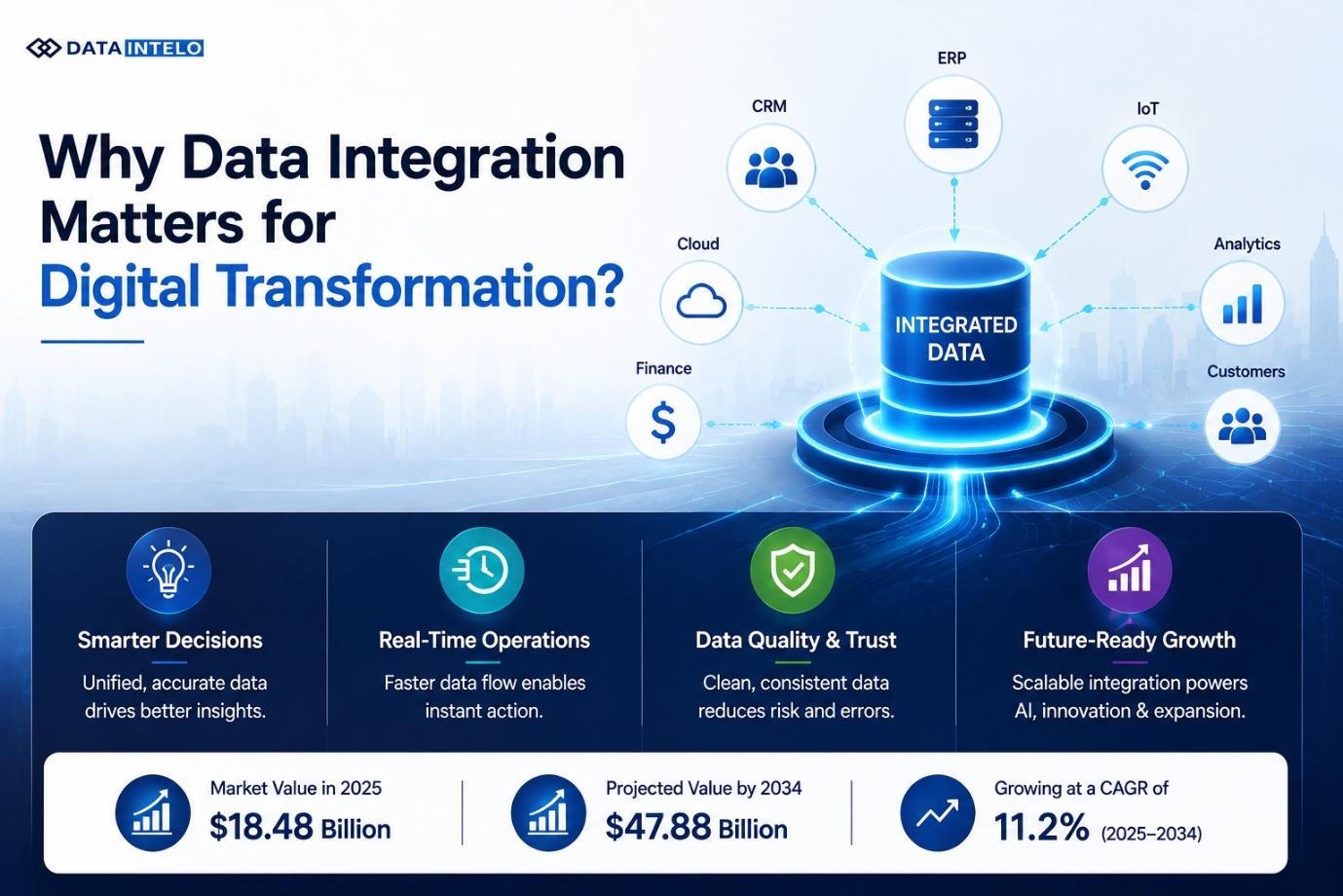
As is reported by Data Intelo, the data integration industry was worth $18.48 billion in 2025 and is expected to grow to $47.88 billion by 2034, which means that the average annual growth rate would equal 11.2% over the given nine-year period.
| Integration Measure | Example |
| Reporting cycle | 48 hours to 6 hours |
| Reporting-time reduction | 87.50% |
| Manual transfers | 40 per week |
| Data error exposure | 5% of 20 million records |
| Event processing | 100,000 events per minute |
Governance and Security Must Progress Along with Integration
Increased connectivity results in the emergence of a variety of channels for the movement of data. This means that integration requires such measures as access control, encryption, monitoring, lineage tracking, data retention policies, and auditing procedures.
A company with 100 applications and 200 active data connections needs to be able to monitor all flows of data. If 5 percent of the activations are not properly monitored, then this means that approximately 10 connections lack the needed oversight.
Role-based access helps prevent the granting of unnecessary permissions. In addition to this, data lineage helps to understand the origin and changes that an item of data has undergone before moving through the systems.
The Next Stage of Digital Transformation
Data integration is taking shape as a must-have architectural attribute rather than just one-off tech activities. For instance, linking up 20 systems results in 190 combination possibilities while linking up 40 systems gives 780 connections, explaining why scalable architectures are necessary for innovative digital ecosystems.
By integrating safe data transportation, solid governing practices, demonstrable quality, and fast processing capabilities, companies can establish better groundwork for AI, automated options, analytics, and connected operations. Ultimately, Data Integration plays a huge role in digital transformation as it guarantees that data travels through secure, reliable, and consistent channels within the complicated environments of businesses.