

The delivery of software projects can get delayed due to numerous reasons that are not directly associated with coding. Requirements that are not clearly defined, wrong assumptions, poor implementations, and excessive rework can take away plenty of time during the development process.
Spec-driven development solves these problems of software development by building the entire project on a well-formed specification. Requirements are no longer seen as additional information but are used in an organized way to define the actual work that needs to be done.
As a result, this approach is able to boost the quality and speed of software production.
What Does Spec-Driven Development Mean?
Spec-driven development is a technique of programming that involves using very detailed specifications to establish what is expected from the system, setting the rules, system’s behavior, interface, acceptance criteria, and requirements.
Specifications can establish something as simple as the interface of an API or something as complex as a whole system architecture. The most important thing is that after using the specification the developer should already know what to expect from the final product.
The specifications also act as a common source of truth for all parties involved in the development process – developers, quality assurance experts, designers, project managers, etc.
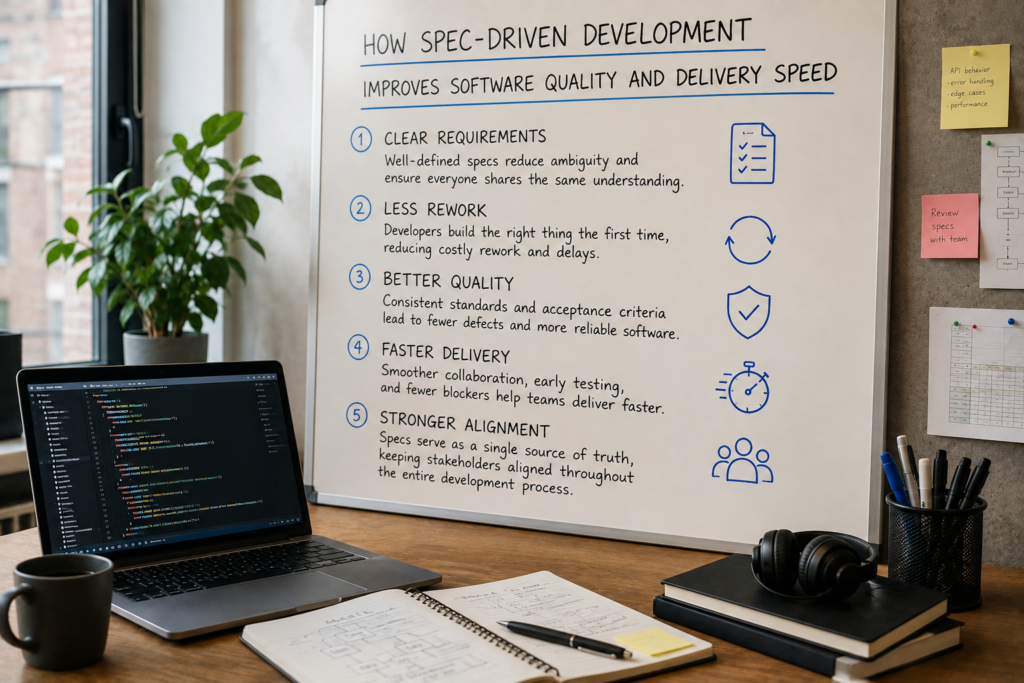
1. Requirements Become Clearer
An ambiguous requirement contributes to development issues. What may seem like a simple function may have different meanings for the product, the engineering, and the QA teams.
An organized specification makes sure that critical aspects of requirement are taken care of at an early stage. The teams would identify what is expected as input, output, user flow, exceptions, dependencies, and acceptance criteria prior to starting the development process.
That lowers the risk of running into misunderstandings after a function has already been built.
Read: How AI Is Transforming the Software Development Lifecycle
2. Developers Spend Less Time on Rework
Rework tends to push deadlines back significantly. If requirements are imprecise, developers might create a system that works properly technically but does not actually deliver what was intended. Spec-driven development provides a clearer goal.
In this way, developers are able to compare decisions made in the course of the process with requirements instead of waiting for the audit or testing stage when inconsistencies can be spotted. Less redundant reworking implies more time for engineering.
3. Testing Starts Earlier
Specifications can serve as the groundwork for test cases. With expected behavior and acceptance criteria being established pre-implementation, the QA teams can immediately identify the expected behavior of a feature without waiting for its implementation first. In fact, it can increase the efficiency of test preparation and its execution simultaneously with the development process.
Thanks to this approach, it becomes easier to spot edge cases, lack of requirements, and conflicting expectations well before they become defects in production.
4. Teams Maintain More Consistent Quality
Quality becomes hard to sustain as software projects get bigger. Numerous developers could make different assumptions on APIs, validation rules, error management, and business logic. The specifications establish a common point of reference.
This becomes important for distributed teams and other projects with many engineering teams. Developers are enabled to make their implementation decisions around the same established framework.
5. AI-Assisted Development Becomes More Reliable
The emergence of AI programming tools makes it imperative to work on specifications. Artificial Intelligence can produce quick code, but poorly written directives can yield results that do not meet the requirements of the product. Clear requirements provide AI programs with better boundaries and results.
Programmers are able to relay structured specifications to help with programming, testing, documentation, and implementation phases and check the produced outcome against the initial requirements in the end.
6. Delivery Becomes More Predictable
Spec-driven development means that more energy is spent in the planning phase. Nevertheless, figuring out requirements at the very beginning saves time in later stages of development.
Consequently, teams encounter fewer unexpected changes in requirements during implementation; the QA teams receive clearer acceptance criteria; and stakeholders share the same understanding of what must be delivered.
As a result, it is not only about coding faster; it is about a more seamless development process with minimum interruptions, miscommunications, and unnecessary iterations.
Final Thoughts
Developers that rely on specifications for their software must take input on key decisions at the very beginning of each project. Teams can then eliminate uncertainties, avoid unnecessary iterations and issues during development itself, and have something to test as early as possible.
Spec-based development has become ever more important with the introduction of machine learning and the necessity of code automation. While this speeds up the coding process, it does not necessarily enhance software delivery. The need for the area of expertise is still present, especially when choosing an AI assisted development partner. For this reason, a company must first specify what exactly needs to be built in every single case.