The Introduction of LIMS
Sample processing is done fast to allow for accurate and timely results, an essential aspect that every pathology lab must attend to. A Pathology LIMS (Laboratory Information Management System) is in place to ensure that every sample is accounted for, tracked, tested, and processed. Integration of Pathology Lab Software with LIMS minimizes errors, increases efficiency, and helps in patient care. The role of LIMS in healthcare is the automation of sample processing and feedback in real time to support an evidence-based decision. In addition, Laboratory Billing Software ensures smooth management of finance while expressing the advantages of LIMS in being integrated into the modern-day laboratory.
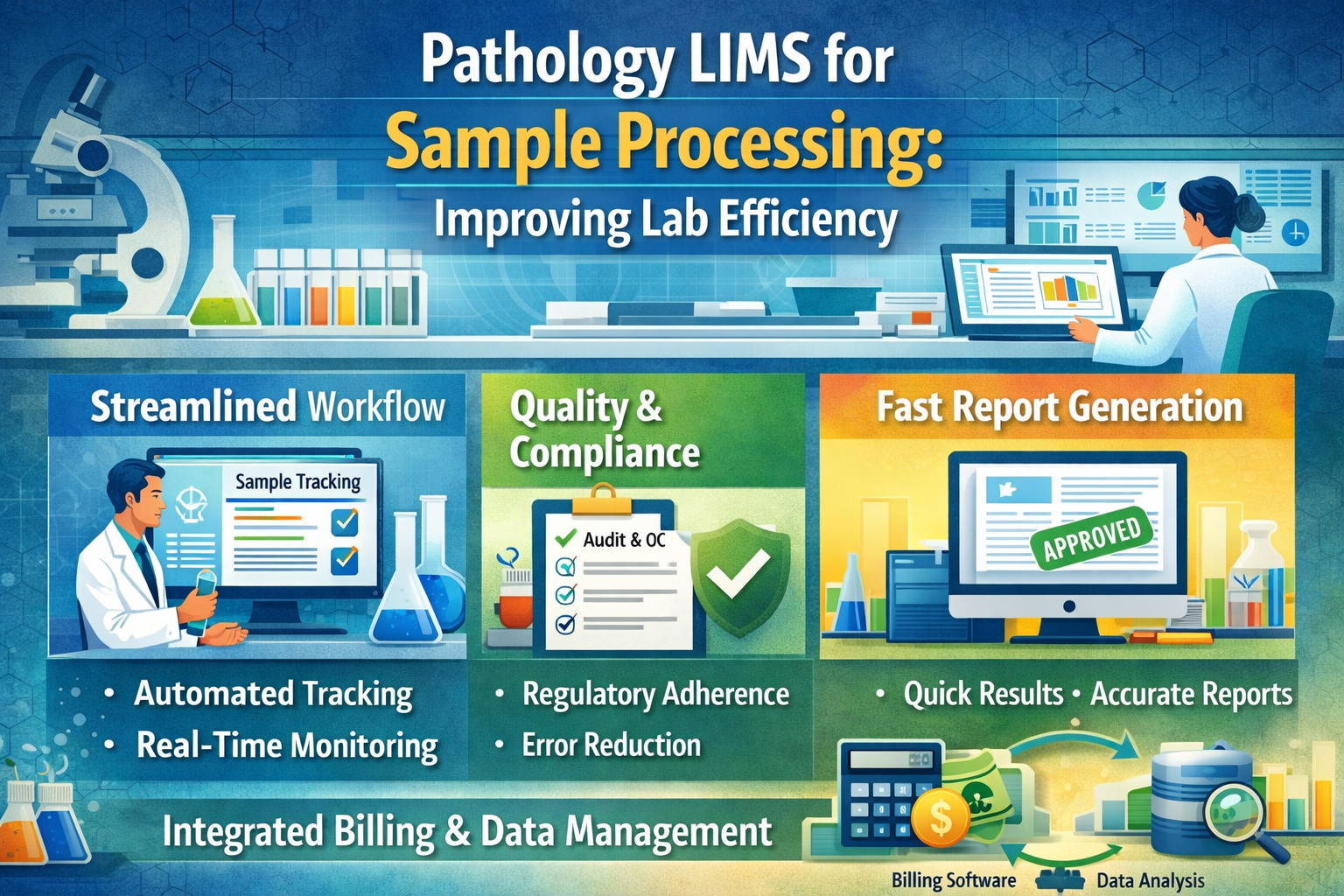
Streamlining Sample Processing with LIMS
Sample processing in pathology laboratories typically involves a multitude of steps, including sample preparation, analysis, and verification. All of these steps may delay, err, or sometimes fall into a state of inefficiency if not duly managed. The Laboratory Information Management System integrates all alternating and sequential stages of the entire sample process flow into one system with a central database, thus allowing for precision and consistent operation of the lab.
The Pathology Lab Software component within the LIMS allows lab personnel to monitor every single sample through its entire lifecycle. Samples are assigned unique identifiers, and status updates occur at every processing stage. This would clear any ambiguity as regards the location or condition of a sample, thereby enhancing coordination among the technicians, supervisors and clinicians. The importance of LIMS in the health sector is demonstrated by the provision of live dashboards by laboratory managers indicating current workloads, tests in progress, and possible bottlenecks thus enabling efficient maximization of resource inputs with minimal delays.
A laboratory management information system also stores historical data on each sample, which enables labs to recognize trends, monitor performance, and carry out audits effectively. Laboratory Billing Software Integration – Having an accurate billing code linked to every test means that the administrative burden will be removed as well as whether the invoices are correct or not. Laboratory information management systems ensure the proper sample processing through accuracy, speed of processing time as well as making the entire workflow easily viewable.
LIMS Use Cases in Sample Processing
Many features for sample operation efficiency and reliability are configured into the laboratory information management system:
- Automated sample tracking: A sample is imported and checked for errors while being monitored in the course of testing to prevent mistakes or misplacing the sample according to the instructions of laboratory management.
- Real-time workflow view: Technicians and supervisors have access to the real-time tracking of tests in the status of pending or completed.
- Standardized procedures: The LIMS ensures that every test is conducted under standard conditions, thus enhancing reproducibility.
- Integration with the finance system and lab billing software: Ensures all tests are tracked by the system for correct billing.
These features further emphasize the essential role of LIMS for healthcare in maximizing efficiency, minimizing error rate, and facilitating turnaround time for diagnosis. If all sample processing activities are concentrated on the laboratory information management system, the pathology lab can concentrate on producing quality reports and thus minimize distraction by paperwork and manual processing.
Ensuring Quality and Compliance
Quality assurance is an important activity in a pathology laboratory. Quality control measures are enforced through a Laboratory Information Management System to ensure compliance with the standard operating procedures, and every aspect of testing is locked for auditing purposes. Pathology Lab Software allows for tracking of each sample from receipt through to reporting, offering total visibility to the lab’s processes.
The LIMS role in health care supports compliance with regulations and accreditation due to detailed logs on equipment calibrations, reagent use, and staff activities. Alerts can be set up for notifying technicians on any deviation from the standard protocol, for instance, unusual test values or delays in processing. Thus, all tests can be monitored proactively for correctness and addressing of issues instantaneously.
A lab management information system also enables the labs to produce reports on operational efficiency, test accuracy, and employee productivity. Interaction with Laboratory Billing Software shall allow for billing of only those tests that are performed and approved, reducing chances for financial discrepancies. The LIMS supports quality and compliance in the laboratory through enhanced error detection, increased degrees of reliability, and an acquired level of trust from both clinicians and patients.
Accelerating Report Creation
Report creation after processing is a vital step in lab workflow. The Pathology Lab Software embedded in the Laboratory Information Management System automates the report generation by appending the test results, formatting them according to clinical standards, and delivering them to appropriate clinicians.
The extent of LIMS in healthcare includes allowing supervisors and pathologists to electronically review results prior to release. In this manner, they add to the accuracy while at the same time reducing the chances of a transcription error. The lab management information system can automatically generate reports from established templates, ensuring uniformity in format and presentation. Moreover, integration with Laboratory Billing Software ensures that all tests included in the report are accounted for in the billing system and assists in easier financial handling.
Benefits of LIMS in Report Generation
- Rapid generation of accurate reports
- Reduced manual errors and enhanced consistency
- Real-time notifications to clinicians and patients
- Better traceability for audit purposes
A pathology LIMS can manage its high test volumes with accuracy and quality for patient care by making sure clinicians have timely and reliable information as required.
Enhanced Laboratory Efficiency
LIMS improves working efficiency in laboratories. First, it automates repetitive operations for real-time monitoring of activities and integrates the workflow. Thus, personnel would have their time unblocked for important testing activities as a result of decongesting administrative bottlenecks.
From a health care perspective, the LIMS allows laboratory managers to keep track of performance parameters, sample processing times, and bottlenecks. This information allows laboratories to improve scheduling of urgent testing and resource allocation. Integration with Pathology Lab Software enables accurate recording of almost all laboratory activities, while Laboratory Billing Software will ensure seamless financial dispatching.
A laboratory management information system is also intrinsically scalable, meaning that as patient numbers rise, laboratory results can increasingly be provided reliably and promptly without over-taxing laboratory personnel or sacrificing quality. Laboratory information management systems will provide opportunities for increasing efficiency through improved productivity, reduced turnaround time, and enhanced laboratory performance.
Role in Data Handling and Research
Besides operational efficiency, a Laboratory Information Management System (LIMS) also plays a key role in data management and research. The LIMS provides a mine of information for clinical research, epidemiological studies, and quality improvement projects since they also keep a meticulous record of all tests, sample information, and patient-related data.
The role of LIMS in healthcare enables pathologists and researchers to analyze trends in test results, monitor the prevalence of disease, and pinpoint areas for rectification in laboratory practice. Integrations with Pathology Lab Software guarantee that the research data is correct, complete, and traceable, whereas Laboratory Billing Software helps to track the financial dimensions of research testing. Benefits of the Laboratory Information Management System in research include enhanced accuracy of data, speed of analysis, and assisting in evidence-based medical decision-making.
Conclusion
In this modern day where samples are processed not only fast but with accuracy and compliance, Pathology LIMS becomes a necessity. It’s the Laboratory Information Management System that really integrates pipelines from sample preparation to report delivery while still being linked to Pathology Lab Software and Laboratory Billing Software. Such integration presents operational and financial efficiencies all the same. The LIMS play in health care ensures that the samples are traceable, diagnostics are faster, and the quality of patient care improves. Thus, the capacity of pathology labs to manage higher volumes, reduce errors, and maximize benefits through the laboratory information management system on daily operations is made possible.
Author’s Bio:
Hi, I’m Parth Makvana, and I work in SEO at Healthray Technologies Pvt. Ltd. I help improve our online visibility while supporting awareness of Healthray products — including Hospital Information Management System (HIMS), and enhance patient care.