Have you ever abandoned an online purchase simply because you weren’t sure the seller would get it right?
Most people have. Maybe it was a personalized gift. Maybe it was printed merchandise for an event. Maybe it was something as simple as a custom sign. You had specific requirements, but the website gave you no obvious way to explain them. So, you hesitated. Then you left.
That hesitation is where a lot of WooCommerce stores quietly lose sales. Not because their products are bad. Not because their pricing is wrong. Because customers can’t easily communicate what they want.
I’ve spent years watching eCommerce businesses obsess over traffic, ad campaigns, conversion funnels, and checkout tweaks while overlooking something surprisingly simple: people want products that fit their needs, not products that force them into a predefined box.
The stores that understand this tend to earn more orders. Not overnight. Not magically. Just consistently. Product customization is often the reason why.
Read: The Ultimate Guide to B2B Ecommerce Consumerization Trends
Difference Between Browsing and Buying
A few years ago, I was helping a small online print shop review its customer journey. Traffic looked healthy. Product pages were getting attention. Yet sales weren’t keeping pace.
At first, everyone assumed pricing was the issue. That’s usually the first suspect. But after reviewing customer emails, a different story emerged. Potential buyers kept asking questions:
“Can I upload my own artwork?”
“Can you adjust the design slightly?”
“What if I need different dimensions?”
“Can I leave instructions before ordering?”
The interesting part wasn’t the questions themselves. It was the fact that people were asking them before they felt comfortable buying.
Customers weren’t looking for discounts. They were looking for certainty. Once the business added customization options directly into product pages, many of those questions disappeared.
Customers could provide details while ordering instead of waiting for email responses. Sales started moving. Not dramatically at first. Then steadily. Because confidence is often the final ingredient missing from a purchase decision.
People Like Products. They Love Ownership.
There’s a subtle psychological shift that happens when customers participate in creating something. A standard notebook is a product. A notebook with your company logo, preferred colors, and custom messaging feels different.
Suddenly, it becomes your notebook. The same thing happens across countless industries. Wedding invitations. Custom packaging. Engraved gifts. Promotional merchandise. Artwork. Event materials.
People naturally place more value on things they’ve helped shape. It’s one reason personalized products often command higher prices without triggering the same resistance buyers might have toward standard products. The purchase becomes emotional. And emotional purchases tend to be surprisingly resilient.
The Email Problem Nobody Talks About
Most store owners have experienced it. A customer places an order. Five minutes later, an email arrives.
“I forgot to mention something.”
Then another email.
“Here’s the file.”
Then another.
“Actually, use this version instead.”
Before long, a simple order has become a scattered conversation spread across multiple inbox threads. It’s exhausting. More importantly, it’s risky. Important information gets missed. Files get lost. Instructions become unclear.
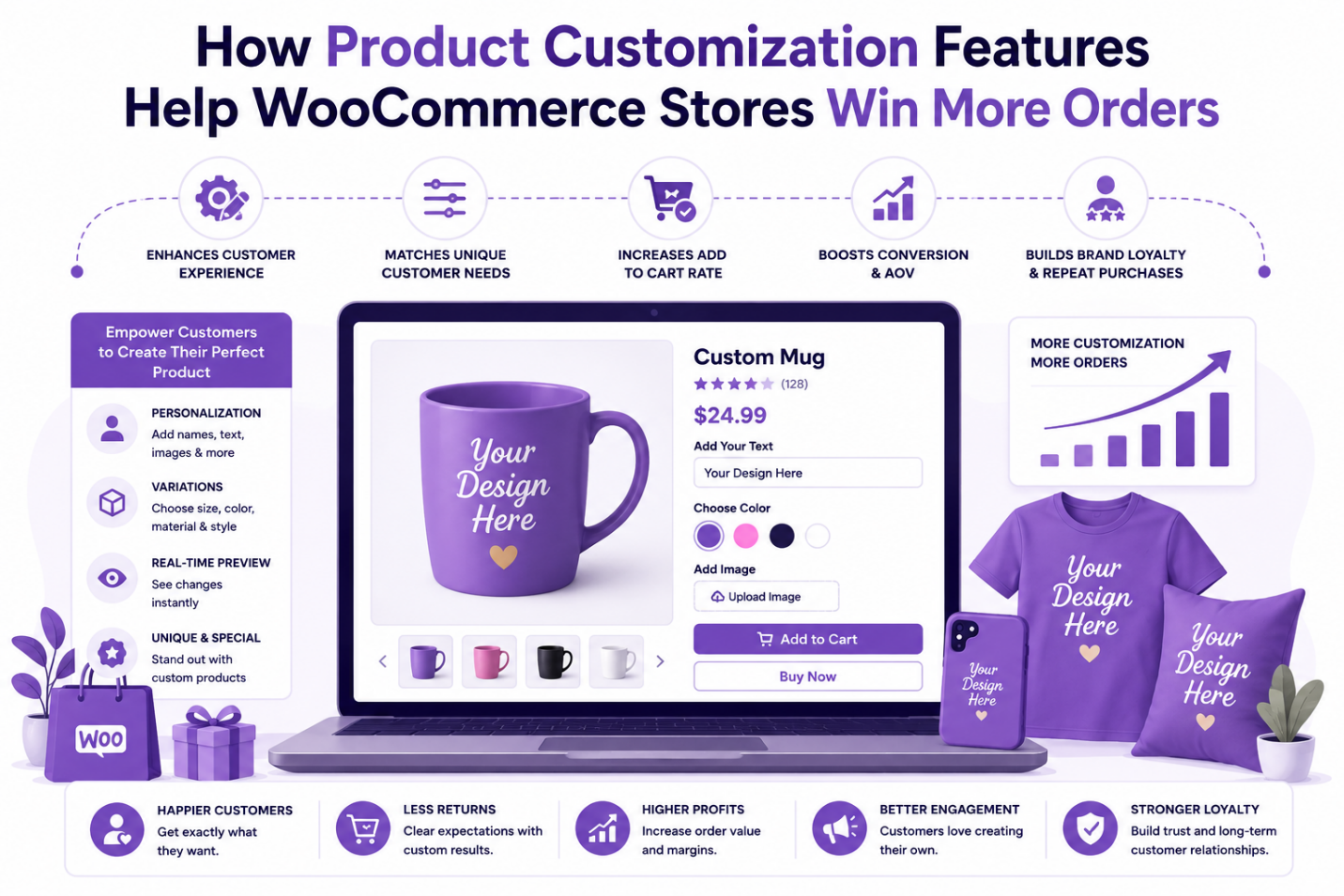
Customization features reduce this chaos by collecting critical information before checkout is completed. The process becomes cleaner for everyone involved. Customers know where to submit details. Store owners know where to find them.
Real Customers Don’t Behave Like Forms Expect Them To
One thing I’ve learned after watching thousands of online purchases is that customers rarely follow the neat little path businesses imagine. You ask for a PNG. They upload a PDF.
You request dimensions. They send a screenshot. You create a carefully structured form. They write an explanation that somehow ignores every field you created. That’s not a criticism. It’s reality.
People think about their projects differently from how businesses think about production processes. The best WooCommerce stores recognize this and build flexibility into their ordering experience.
Instead of forcing customers to adapt, they create systems that accommodate real-world behavior. That flexibility matters more than many merchants realize because every point of friction becomes a potential reason not to buy.
Why Convenience Quietly Wins Sales
Customers rarely say, “I purchased because your ordering process was convenient.” That’s not how people think. But convenience influences behavior constantly.
Imagine two stores selling nearly identical products. One requires customers to place an order, wait for instructions, then send files separately. The other lets customers provide everything during checkout.
Which feels easier?
Which feels more professional?
Which feels more trustworthy?
The answer is obvious. Yet many businesses still create unnecessary steps. Every extra action gives customers another opportunity to reconsider. Or get distracted. Or leave. Convenience doesn’t always feel exciting from the seller’s perspective. Customers notice it immediately.
Most Successful Stores Remove Uncertainty
A lot of conversion advice focuses on persuasion. Better headlines. Stronger offers. More urgency. Those things matter. But uncertainty is often the bigger problem. Customers wonder:
- Will my logo print correctly?
- Did they understand my instructions?
- Can they work with my file format?
- Will the finished product match what I’m imagining?
The less uncertainty a customer feels, the easier it becomes to move forward. That’s why customization features frequently outperform flashy marketing tactics. They answer concerns before those concerns become objections. That’s a much more sustainable way to increase conversions.
Customization Changes How Customers Compare You
When products are identical, buyers compare prices. When experiences differ, buyers compare value. That’s a crucial distinction. A generic product can be purchased almost anywhere. A personalized experience is harder to replicate.
Once customers begin interacting with customization options, uploading materials, adding requests, and tailoring the order to their needs, they stop viewing the purchase as a commodity.
The conversation shifts. They’re no longer asking, “Who’s cheapest?” They’re asking, “Who can deliver exactly what I need?” Those are very different buying decisions. And the second one is usually more profitable.
Small Features Can Create Outsized Results
One of the most common misconceptions in eCommerce is that meaningful growth requires major changes. Sometimes it does. Often it doesn’t. I’ve seen stores improve performance by adding surprisingly small enhancements:
- A file upload option.
- A notes field.
- Better customization instructions.
- Required information fields.
- Clearer communication during checkout.
None of these changes would make headlines. Most customers won’t even consciously notice them. But collectively, they remove friction. And friction is expensive. Every obstacle between interest and purchase costs revenue. Sometimes more than businesses realize.
Why File Upload Capabilities Have Become Essential
For stores selling personalized products, collecting customer files is no longer a nice extra feature. It’s becoming an expectation. Buyers want to submit logos, artwork, reference images, documents, and instructions without jumping through hoops.
The ability to support WooCommerce upload files functionality directly on product and checkout pages helps create a smoother experience while reducing administrative work behind the scenes.
Tools such as the WooCommerce custom file upload plugin for orders allow merchants to gather customer assets during the purchasing process rather than chasing information afterward. That creates a more organized workflow and often shortens fulfillment timelines as well.
Customers don’t always notice the technology. They notice how easy everything feels. That’s what matters.
Human Side of Personalization
The conversation around customization often focuses on features. Fields. Uploads. Plugins. Settings. Useful things, certainly. But the deeper reason customization works is surprisingly human.
People want to feel understood. They want confidence that their vision won’t get lost somewhere between checkout and fulfillment. A personalized ordering experience communicates something subtle but powerful: “We’re listening.”
That message builds trust. Trust creates purchases. Purchases create long-term customers. Not every shopper will use customization options. Not every product requires them.
But for stores selling products with even a small degree of personalization, giving customers a direct way to communicate their needs can dramatically improve the buying experience. Often, the buying experience is what separates a completed order from a missed opportunity.
Conclusion
To conclude, WooCommerce stores don’t win more orders just because they use up more on ads or offer bigger discounts. They win because they make things simple for the buyer. When people can quickly understand what they’re buying and how to get it. They’re more likely to place an order.
Product customization helps make this possible. It deletes confusion, reduces the need for extra messages and lets customers shape the product the way they want. Instead of choosing from fixed options. This makes the buying process more personal and easy to follow. Features like WooCommerce upload files also favors a lot. Because customers can directly send images or instructions. So the store knows exactly what the customer is looking for and can make it the right way the first time.